Skip to content

If you are missing more than one tooth, you may be wondering whether every gap needs its own implant.
Not always. One implant usually replaces one tooth, but a bridge or a full-arch plan can use fewer implants than the number of missing teeth. At Dental Clinic Islamabad in F-7 Markaz, we check your bone, bite, and tooth position first, then plan the number of dental implants your case actually needs.
Quick Answer
In most cases, one implant replaces one tooth. In select cases, such as small lower front teeth, one implant may support two connected teeth. Two implants can usually support a three-unit bridge, and four to six implants can support a full arch. Bone health, bite force and tooth position decide the final number.
How Do Dental Implants Replace Missing Teeth?
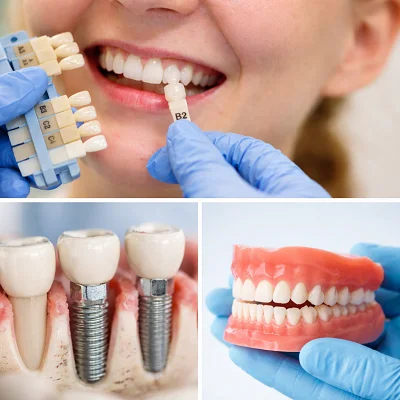
A dental implant is a small post, usually titanium, placed in the jawbone. Over time it fuses with the bone and acts like a tooth root.
Once healed, it can hold a single crown, a bridge, a full-arch restoration or an implant-retained denture. Because it works like a root, it also helps keep the jawbone stimulated, which a conventional bridge or denture does not do.
Front Teeth vs Back Teeth: How Implant Support Differs
The position of the missing tooth changes how an implant is planned. Front teeth and back teeth handle very different chewing forces.
| Area | Chewing Force | Approach |
| Front teeth | Lighter | Usually one implant per tooth. Two connected teeth on one implant only in select cases, mostly lower front |
| Premolars | Moderate | Usually one implant per tooth |
| Molars | Heavy | Separate implants are usually planned |
What Are a Pontic and a Cantilever?
These two terms come up often when your dentist explains an implant-supported bridge.
- A pontic is the artificial tooth in a bridge that has no implant of its own. It is joined to the crowns on either side, and those crowns sit on implants. This is how two implants can support three teeth.
- A cantilever is an extension supported from one side only. It can work in carefully selected cases, but it puts more stress on the implant, so dentists use it cautiously, especially in the back of the mouth.
How Many Implants Are Needed for Multiple Missing Teeth?
The number of implants does not have to match the number of missing teeth. These are common patterns, not fixed rules.
| Situation | Typical Approach |
| 1 missing tooth | 1 implant with 1 crown |
| 2 to 3 missing teeth in a row | Often 2 implants supporting a bridge |
| Several missing teeth in a row | More implants with a longer bridge |
| Most or all teeth missing in one jaw | 4 to 6 implants supporting a full arch |
How Many Implants Are Needed for a Full Arch?
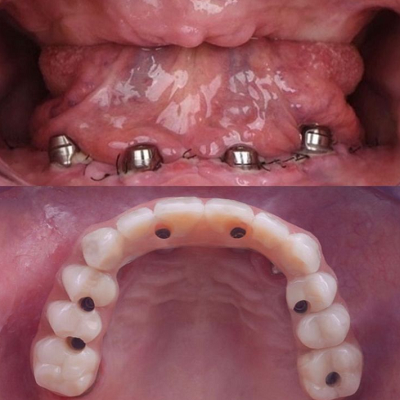
You do not need an implant under every tooth. All-on-4 uses four implants to support a full arch, usually around 10 to 12 teeth. All-on-6 uses six implants to provide extra support. Dentists may recommend this option for certain jaw structures or when patients need greater stability.
Which one suits you depends on your jawbone, your bite and the design of the final teeth. Your dentist will explain both if you are a candidate.
What Decides the Number of Implants?
Our dentist looks at five things before recommending a plan.
- Bone quantity and quality: Implants need enough healthy bone. If bone has shrunk after tooth loss, bone grafting may be needed before or along with placement. We may use X-rays or 3D imaging to check.
- Tooth location: Molars take far more chewing force than front teeth, so back teeth usually need stronger support.
- Bite force: If you grind or clench, extra stress falls on the implants. A night guard is sometimes advised after treatment.
- Number and position of missing teeth: One missing tooth usually needs one implant. Several teeth in a row may allow a bridge on fewer implants than teeth.
- Gum and overall oral health: Active gum disease, poor hygiene, and smoking raise the risk of complications around an implant.
These factors work together. That is why we confirm the final number only after an exam, not from the count of missing teeth alone.
What Happens If an Implant Is Overloaded?
If a restoration puts too much pressure on an implant, it can loosen, wear down, cause bone loss around the implant, or in serious cases, fail. This is why we evaluate your bite before deciding the number of implants.
Using fewer implants than your case needs is not a shortcut worth taking. Fewer implants can mean fewer surgical sites and lower cost, but only when they can safely carry the load.
Plan Your Implant Treatment at Dental Clinic Islamabad
Not sure how many implants your gap needs? Book a consultation at our F-7 Markaz clinic with our oral and maxillofacial surgeon, Dr. Sundas Rashid. We will check your bone, bite, and missing teeth, and give you a clear treatment plan and quote.
Call At: 0332 5488777
Clinic Address: 3rd Floor, Ammar Center, Jinnah Super Market, F-7 Markaz, Islamabad